
DNS Database - A System of Turbulent Shear Layers and Vortices
Introduction
Direct numerical simulations (DNSs) of a turbulent shear layer vortex interaction case have been performed on
Flow configuration and example results
As shown in the z-averaged vorticity figure below, a temporally evolving thin mixing layer is initialised with equal and opposite freestream velocities: $\pm \Delta U/2$. The flow is periodic in the streamwise (x) and axial (z) directions with a uniformly spaced mesh. The (z) direction is used for averaging to enable comparison to Reynolds-Averaged Navier-Stokes (RANS) solutions. The (y) mesh is stretched to cluster points within the mixing layer. The ratio of axial to streamwise domain lengths is set to: Lz / Lx = 10, for periodic streamwise length Lx= 10. Mesh points are distributed as (Nx, Ny, Nz) = (1000, 1267, 10000). Sensitivity of the DNS results to mesh resolution, domain and averaging length is demonstrated in [1] (Lusher et al, TCFD (2026)).
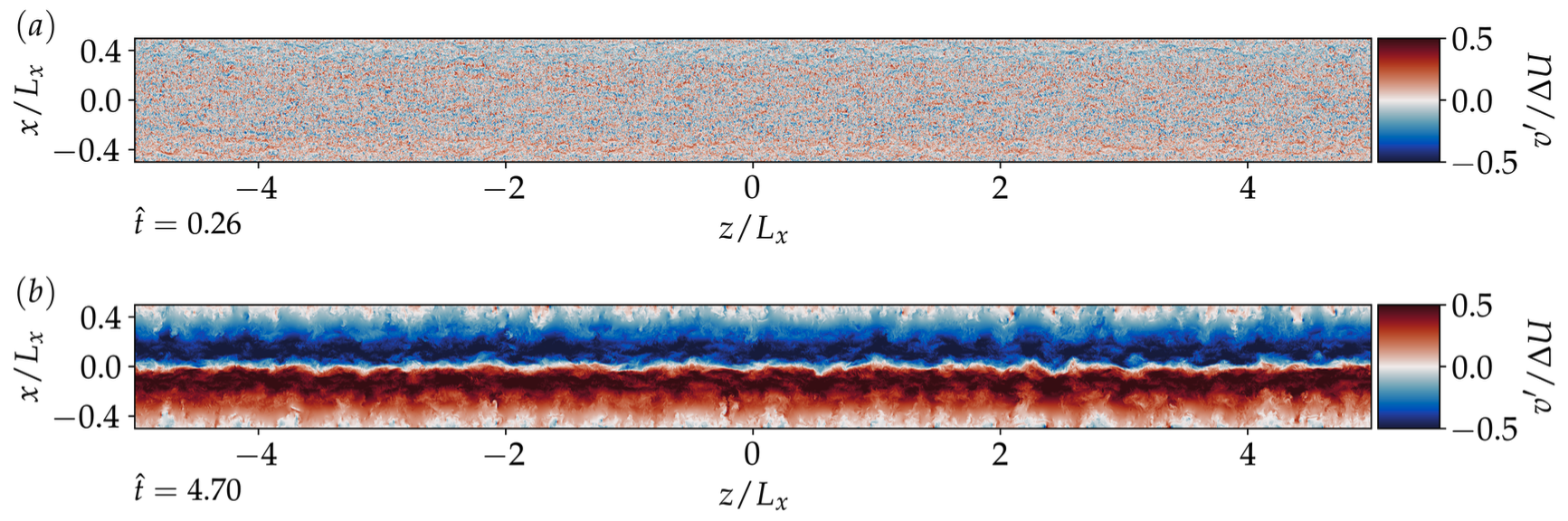
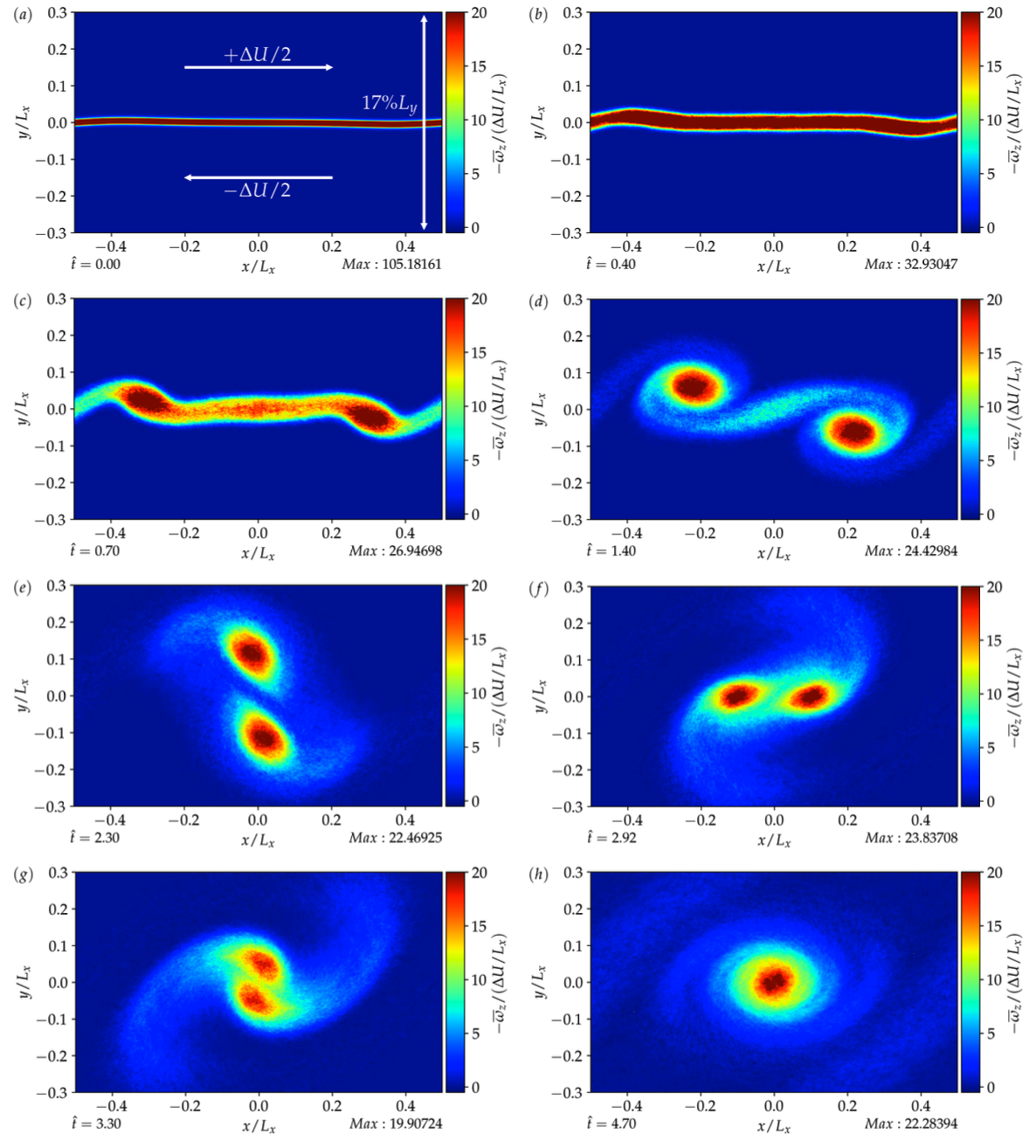 A weak soliton-like wave profile is imposed on the initial condition to promote the formation of two primary vortices via the Kelvin-Helmholtz instability. The initial mixing layer is seeded with square-wave-filtered random perturbations to trigger a rapid transition to turbulence prior to the roll-up of the vortex pair, as shown in the (x,z) plane velocity perturbations at y=0 below.
After the initial growth of the turbulent shear layer and formation of the vortices, the shear layers wrap around the vortices to resemble the flow physics observed on wings. The vortices co-rotate and later merge, forming a single turbulent vortex core. All these flow stages are challenging for RANS models to accurately reproduce.
The soliton-like wave profile used to initialize the flow is:
$u(x,y,\hat{t}=0) = {\Delta U\over2} \tanh\left(\frac{y - y_1\Psi(x)}{y_0} \right)$,
$\Psi(x) = -\sin\left(\frac{2\pi x}{L_x}\right)\exp\left[-{L_x^2\over 2\pi^2 x_e^2}\left(1+\cos\left({2\pi x\over L_x}\right)\right)\right]$
Here, $y_0 = 0.005L_x$ is 1/2 the vorticity thickness of the layer. The quantity $x_e = 0.2L_x$ sets the location of the roll-up. The constant $y_1 = 0.01L_x$ corresponds to the amplitude of the perturbation $\Psi(x)$ and the dependence on $\sin(2\pi x/L_x)$ and $\cos(2\pi x/L_x)$ ensures that the field is exactly periodic.
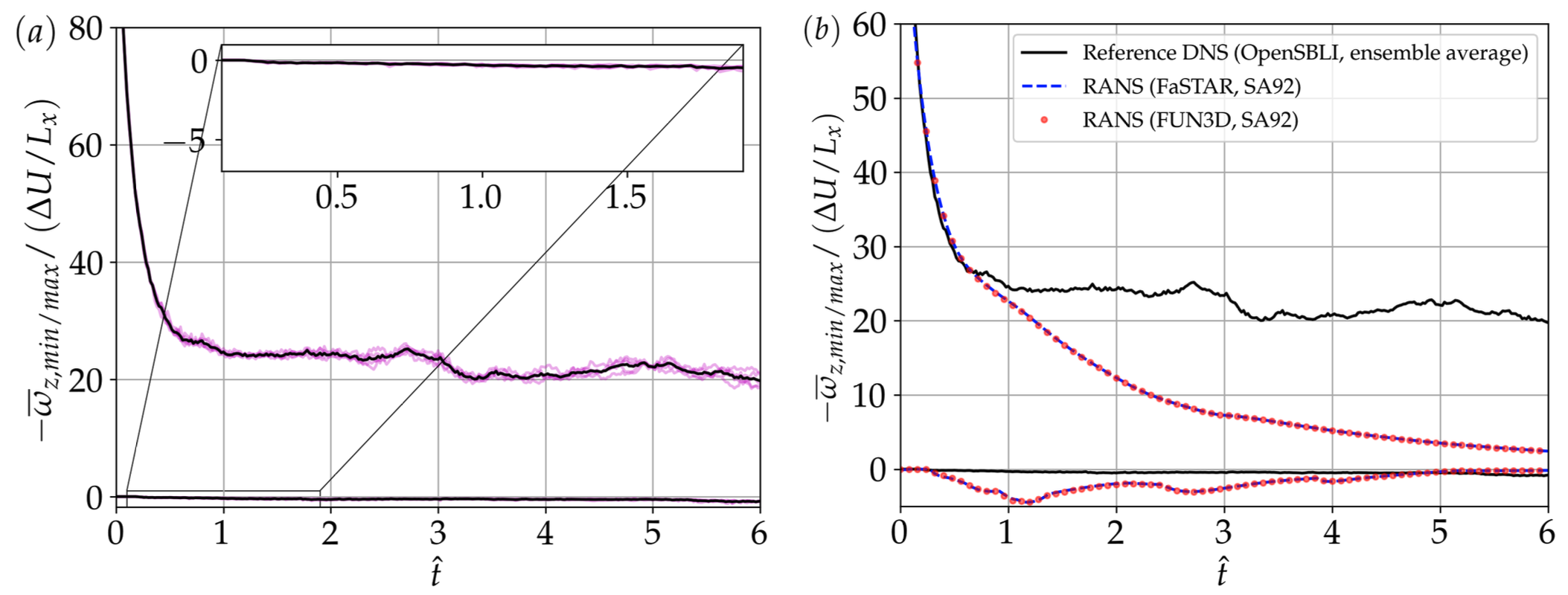
The second panel (b) shows the agreement between the URANS solutions and reference DNS during the initial development of the turbulent shear layer. The profiles diverge from the reference result once the vortices form within domain. The URANS solutions are provided by both the FaSTAR (JAXA) and FUN3D (NASA) CFD solvers, providing an additional cross comparison between numerical solvers and methodologies.
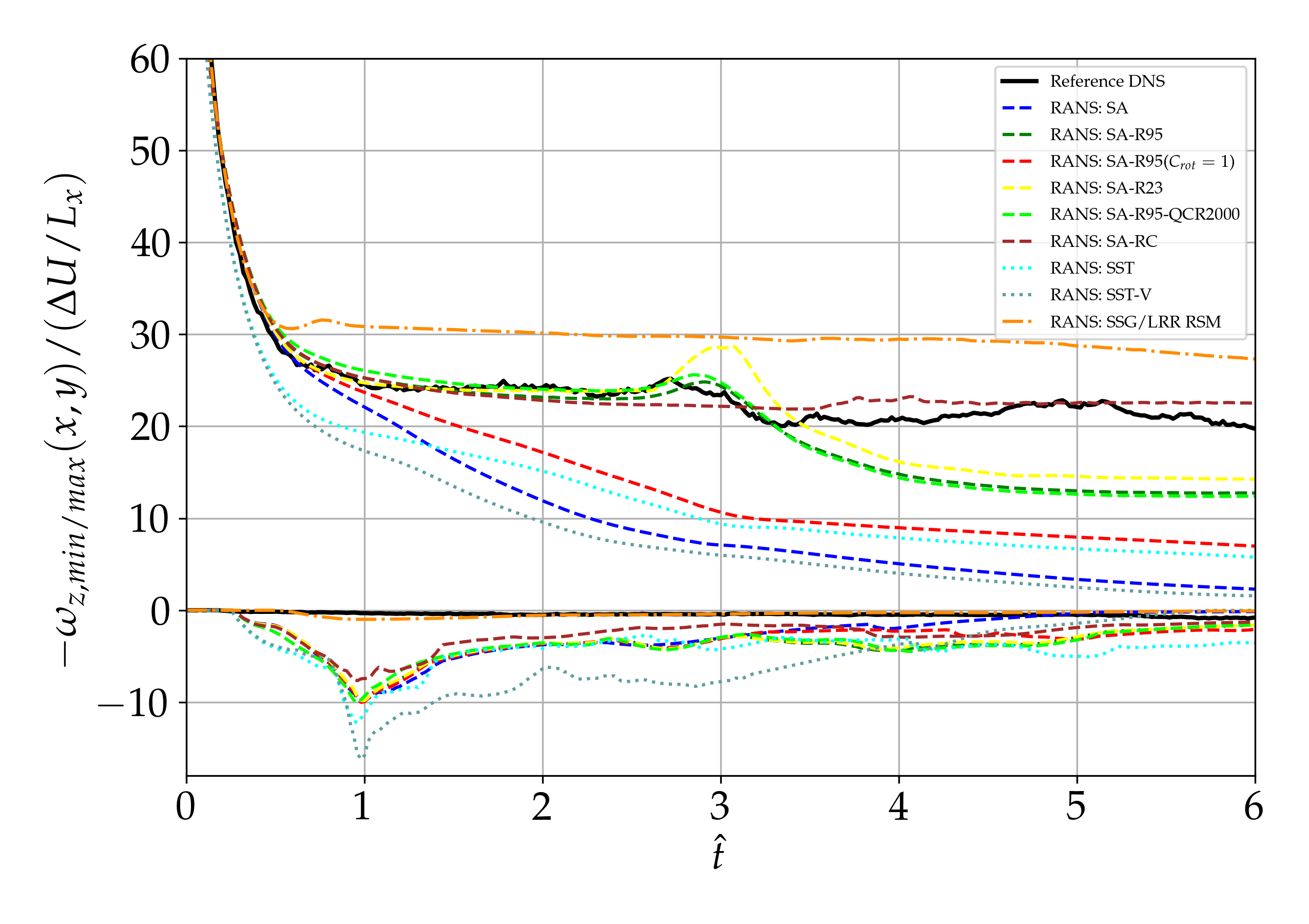 URANS: The left figure displays URANS solutions for the time evolution of peak minimum/maximum vorticity across a range of common turbulence models and corrections. While the models maintain good agreement with the reference DNS solution (black) during the initial development of the turbulent shear layer, a large spread is observed across predictions once the vortices form. The RANS flow fields also develop regions of spurious opposite sign vorticity, not present in the DNS.
A full description of the RANS initialization procedure and model results are provided in:
A. Sansica, D.J. Lusher, L. Wang, G.N. Coleman, P.R. Spalart. Study of a System of Turbulent Shear Layers and Vortices. Part II: Reynolds Averaged Turbulence Modelling. Theoretical and Computational Fluid Dynamics (2026).
Statistics Downloads
Turbulence statistics are provided for a range of quantities
Full descriptions of the case setup, numerical parameters, and results are provided in:
D.J. Lusher, A. Sansica, G.N. Coleman, P.R. Spalart. Study of a System of Turbulent Shear Layers and Vortices. Part I: Direct Numerical Simulation and Theoretical Considerations. Theoretical and Computational Fluid Dynamics (2026).
| Mesh Resolution | Circulation Re | Domain: Lz / Lx | Convective Mach Number | |
|---|---|---|---|---|
| (1000, 1267, 10000) | 250,000 | 10 | 0.2 | Download |
The statistics files are provided in ascii Tecplot (.dat) format.
This DNS database is the result of collaborative work as part of the NASA-JAXA Cooperation on Aerodynamics Turbulence Modeling, SAA JA-0692-0, undertaken by Dr. David J. Lusher and Dr. Andrea Sansica (JAXA Chofu), Dr. Gary N. Coleman and Dr. Li Wang (NASA Langley), and Dr. Philippe R. Spalart.
All DNS cases were performed on CPUs/GPUs in the OpenSBLI open-source CFD solver. Full details on the code implementation and numerical methods are available in [3,4].
Computational resources were provided by JAXA’s JSS3 supercomputer, and the Fugaku supercomputer on HPCI project hp240129.
References
- [1] D.J. Lusher, A. Sansica, G.N. Coleman, P.R. Spalart. Study of a System of Turbulent Shear Layers and Vortices. Part I: Direct Numerical Simulation and Theoretical Considerations. Theoretical and Computational Fluid Dynamics 40 (4), 21 (2026). DOI: https://doi.org/10.1007/s00162-026-00788-y
- [2] A. Sansica, D.J. Lusher, L. Wang, G.N. Coleman, P.R. Spalart. Study of a System of Turbulent Shear Layers and Vortices. Part II: Reynolds Averaged Turbulence Modelling. Theoretical and Computational Fluid Dynamics (2026). DOI: https://doi.org/10.1007/s00162-026-00789-x
- [3] D.J. Lusher, A. Sansica, N.D. Sandham, J. Meng, B. Siklosi, A. Hashimoto. OpenSBLI v3.0: High-fidelity multi-block transonic aerofoil CFD simulations using domain specific languages on GPUs. Computer Physics Communications 307, 109406 (2025). DOI: https://doi.org/10.1016/j.cpc.2024.109406
- [4] D.J. Lusher, S.P. Jammy, N.D. Sandham. OpenSBLI: Automated code-generation for heterogeneous computing architectures applied to compressible fluid dynamics on structured grids. Computer Physics Communications 267, 108063 (2021). DOI: https://doi.org/10.1016/j.cpc.2021.108063
- A high priority was placed on the accuracy and convergence of the DNS statistics. Users however are reminded that their accuracy is within a certain limit imposed by the grid resolution and numerical scheme employed. The database may be updated without any notification.
- When publishing the results using the downloaded data, users should clarify the source of the data, such as by quoting the above references.
-
Disclaimer : JAXA Policy (https://global.jaxa.jp/policy.html)
Please be aware in advance that: Although JAXA has taken every care to manage the Site, JAXA assumes no responsibility regarding the safety of the contents of the Site or the reliability of information provided on the Site. JAXA is not responsible to you for any damage that may be caused by the use of the Site and/or the information on the Site. JAXA may change or delete the information on the Site, or may suspend or terminate the operation of the Site without any prior notice. JAXA is not responsible to you for any inconvenience that may be caused by such changes or deletion of the information, or by such suspension or termination of the operation of the Site. - Rights for all information including the data, pictures and charts in this database are reserved by JAXA.